iklan mudah

Sabtu, 16 Februari 2013

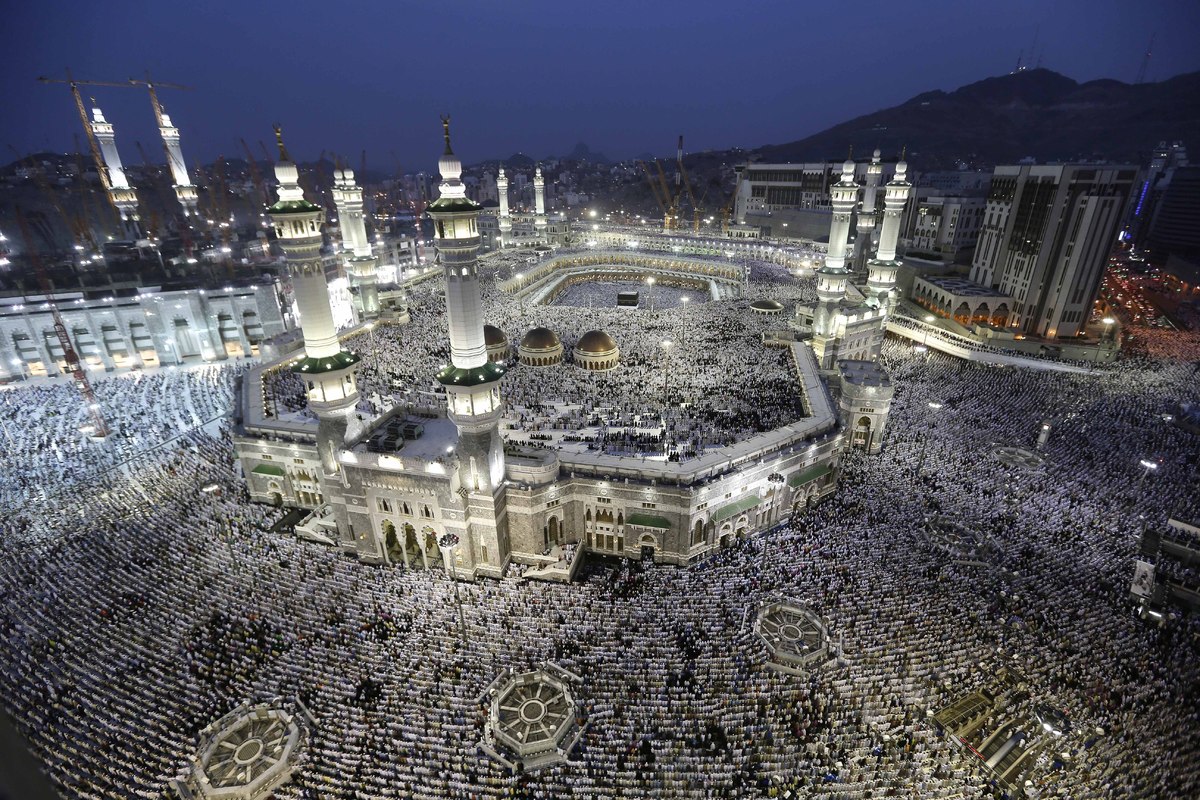
Haj 1434 - 2013

Haj 1434 - 2013
________________________


Official Key Dates for Haj 1434/2013


Haj First Day: 8 Dh-Hijjah - 13 Oct
Arafat Day : 9 Dh-Hijjah - 14 Oct
Eid al-Adha : 10 Dh-Hijjah - 15 Oct


- First day of arrival in the Kingdom for pilgrims is 1st of Dhu al-Qidah 1434 H - 7th September 2013.

- Last date for arrival of pilgrims in the Kingdom by air, at the King Abdulaziz International Airport, Jeddah,
or at the Prince Muhammad bin Abdulaziz International Airport, Madinah is 4th of Dhu al-Hijjah 1434 H - 9th October 2013.

- Last date for pilgrims to travel from Jeddah to Madinah by bus is 25th of Dhu al-Qidah 1434 H - 29th September 2013.

- Last date for pilgrims to travel from Jeddah to Madinah by air is 2nd of Dhu al-Hijjah 1434 H - 7th October 2013.

- Last date for pilgrims to travel from Madinah to Makkah by bus (before Haj) is 5th of Dhu al-Hijjah 1434 H - 10th October 2013.

- Last date for pilgrims to travel from Madinah to Jeddah by air (before Haj) is 6th of Dhu al-Hijjah 1434 H - 11th October 2013.

- Final date for departure (return trip) is 15th of Muharram 1435 H - 18th November 2013.


Important dates for Pilgrims


Dates of receipt of applications for Hajj visas

The last date for receiving applications for Hajj visas from the embassies and representations Custodian of the Two Holy Mosques outside the Kingdom is the 25th of Dhu al-Qi'dah of each year according to Hijri calendar*.

Validity of Hajj visas

The Hajj Visas for pilgrims coming by air will expire by the end of Dhu al-Hijjah, and no later than the 15th of Muharram of the year which followed. And the date of coming back must be according to the dates of travel tickets.

The last date of pilgrims coming by sea is the end of Muharram.
The last date of pilgrims coming by bus is 5th of Muharram.

Dates of arrival for Pilgrims coming by Land

Last date for arrival of pilgrims to the Kingdom by land is the end of the Zil Qadh of each year according to the Hijri calendar*.

Dates of arrival for Pilgrims coming by Air

Last date for arrival of pilgrims in the Kingdom by air, at the King Abdulaziz International Airport, Jeddah,
or at the Prince Muhammad bin Abdulaziz International Airport, Madinah is the 4th of Dhu al-Hijjah of each year.

Dates of arrival for Pilgrims coming by Sea

Last date for arrival of pilgrims to Jeddah Islamic Port is the 4th of Dhu al-Hijjah of each year.

Dates of travel to Medina after arrival

Last date for pilgrims to travel from Jeddah to Madinah by Bus is the 25th of Dhu al-Qi'dah of each year.
Last date for pilgrims to travel from Jeddah to Madinah by Air is the 2nd day of Dhu al-Hijjah of each year.
Last date for pilgrims to travel from Medina to Makkah by Bus (before Hajj) is the 5th of Dhu al-Hijjah of each year.
Last date for pilgrims to travel from Medina to Jeddah by Air (before Hajj) is the 6th of Dhu al-Hijjah of each year.


* Hijjri calendar is based on Umm Al-Qura calendar.

http://www.saudiairlines.com/portal/...00d59618acRCRD

Rabu, 02 Januari 2013


Mataf Expansion Project


-The proposition of a project to increase the capacity of the mataf was shown to King Abdullah in Ramadhan 1432 Hijri who directed to start implementing it.

-King Abdullah assigned the Ministry of Higher Education, General Authority of Masjid al Haram and Masjid al Nabawi and Saudi Bin Laden Group (Working team) to finish the studies on developing the proposed solution.

-The working team recommended a number of studies which were presented to King Abdullah, as follows:

1-Studies regarding air movement in Mataf Expansion and First Saudi Expansion.
2-Studies regarding the building structure of the First Saudi Expansion.
3-Studies regarding Automated systems for Tawaf and Sa'ee for people with special needs.
4-Studies regarding systems for shading the new mataf and the roof of Haram.
5-Studies regarding crowd movement through an integrated system beginning from outside Masjid-al-Haram and the areas surrounding it.

-King Abdullah ordered that these recommended studies be conducted urgently.

-The proposed design was shown to the Supreme Hajj Committee after the Hajj Season of 1432H and they ordered to conduct studies regarding increasing the width of the

Mataf with repititive floors and studies regarding re-building the structure of the First Saudi Expansion.

-The team of Ministry of Higher Education and General Authority of Masjid-al-Haram and Masjid-al-Nabawi arranged a work shop with the Security forces in the month of

Rabi-ul-awwal 1433H to inform them about the proposed design and to take their opinion and to find out their demands.

-The meetings of the working team continued in order to develop the proposed solution including the observations and recommendations of the security forces. Some of

the important observations which were taken into account are:
1-Studying and assessing of the structural system of the First Saudi Expansion.
2-Paying attention to crowd movement and fragmentation of human blocks inside and outside Masjid-al-Haram.
3-To Facilitate the entry and exit movement in the entrances of the Masjid al Haram building so as to provide safety and security to the visitors.
4-Preparing passages and roads leading to Masjid al Haram and developing a guidance system to facilitate the arrival and departure.
5-Developing a system for shading the mataf courtyard and the roof of Masjid al Haram and the external squares surrounding it.
6-Providing specific and separate passages to people with special needs and the elderly and developing an automated system to serve them.
7-The importance of linking (the Mataf) with the Third Saudi Expansion and activating the basement level.

-The Ministry team assigned a number of consulting offices (in the field of structural studies and supporting and re-enforcing structures) to study and assess the structural system of the First Saudi Expansion and its ability to cope with the above-mentioned demands. The results of this study suggested that the current structure was unable to support additional upper floors and future demands.

-The Ministry team and a representative of the Genral Authority recommended that the First Saudi Expansion should be rebuilt complying with the same standards that were used in building the Third Saudi Expansion.

-Based on the above, the proposed project was developed to raise the capacity of the Mataf and the parts attatched to it. Part 1/2

________________________
http://www.skyscrapercity.com/showthread.php?t=1437182&page=24

Current State
First Saudi Expansion

Horizontal Projections


Longitudinal Sector of Mas'aa


Initial Design
Basement Floor


Ground Floor
  
First Floor

  
Second Floor


 Comparison between Current State, Initial Design and the Mas'aa.


Minggu, 28 Oktober 2012

''4 million pilgrims'' performed Haj this year


Monday 29 October 2012

Nearly four million pilgrims have performed Haj this year, Makkah Gov. Prince Khaled Al-Faisal announced yesterday.

“This year’s pilgrimage was a resounding success,” he said.

Addressing a press conference here, Prince Khaled urged the international media to highlight the great Haj message that Muslims are a peace-loving people can coexist peacefully with others.

“Islam is a religion of moderation and service to humanity. It is a religion of peace and love and calls for peaceful coexistence with others,” the governor said. “Unfortunately only negative things about Islam and Muslims are highlighted by the media.”

Haj is a unifying factor, he added.

“Pilgrims wear the same form of dress, live in the same areas, move through the same places and perform the same rituals. They give a good message to the world that the unity of Muslims is not a danger to the world but it will be beneficial to the world.”

Referring to media criticisms, he said: “We welcome constructive criticisms from the traditional and social media. If we want reforms we have to begin it from ourselves.”

Speaking about measures to stop illegal pilgrims, he said: “There is a plan to construct a wall around the holy sites. It has been passed by the Cabinet last Ramadan.”

The Cabinet has approved three projects: A comprehensive development plan for Makkah, the public transport plan for the city and the development plan for holy sites.

Prince Khaled, who is chairman of the Central Haj Committee, said the entry of illegals through the main entrances of the holy sites would be prevented. “If we can prevent undocumented pilgrims coming through Arafat we can reduce their number to a great extent.”

He emphasized the possibility of promoting low-cost Haj services to reduce illegal pilgrims. “We have got a number of proposals to get rid of squatters in the holy sites. We have to be very strict in dealing with illegals,” he added.
He attributed the increase in undocumented pilgrims to a lack of punishment. “We have to set out punishments and implement them strictly next year. We should not allow them to abuse Haj and the regular pilgrims.”

According to the General Statistics Department, 3.16 million performed Haj this year. “But the latest report from Jamrat said that on the first day of Eid more than 3.65 million performed the stoning ritual. So about 4 million pilgrims have performed Haj this year,” he added.

“Unfortunately, there were a large number of undocumented pilgrims who created many problems and the majority of them are non-Saudis,” he said and estimated the number of undocumented pilgrims at 1.4 million.

Prince Khaled said the government had not made preparations for the undocumented pilgrims. “By the Grace of God, everything went well without any problems. And it is one of the most successful pilgrimages in recent years.”

He said more than 120,000 security officers were deployed on Haj duty.
He said the expansion project for the holy sites should be carried out in coordination with all related departments and should cover housing, transport and services.

Prince Khaled emphasized that pilgrims should obtain a high degree of civilization. They should respect and support one another, follow regulations,” he added.

“The Haj congregation is a unique incident in the world,” he said and commended all those who have participated for its success, including volunteers and scouts.

“This is not a political or economic meeting. It is a gathering to worship Allah. It brings together Muslims from all over the world, despite their race, language and color,” he said. He said he was not aware of any anti-regime rally carried out by Syrian pilgrims near Jamrat.

The prince emphasized the need to educate pilgrims before they come to the Kingdom in order to have better results.

“Awareness programs inside the Kingdom will have little effect if pilgrims did not receive proper Haj awareness in their countries,” he said.
Haj gives Muslims a big lesson. “If Muslims perform their Haj rituals with sincerity to receive the pleasure and reward of God, get rid of their differences and unite, they will become a strong nation and can achieve success.”

Speaking about problems faced by pilgrims at the Mashair Railway, he said it would take some time until we reach perfection in operating this transport system. He said action would be taken against those responsible for the delay in transporting pilgrims through the railway.

http://www.arabnews.com/four-million...ormed-haj-year

Pilgrims rush to complete final Haj rituals

Sunday 28 October 2012

MINA: Pilgrims rushed to complete the final rituals of the annual Haj on Sunday, thronging a devil-stoning site on the penultimate day of the pilgrimage.

Most pilgrims will hurl rocks at three pillars representing Satan between noon and sunset, leaving the holy city of Mina before dusk.

But others will stay on in Mina until Monday when they will perform the stoning ritual one final time.

Worshippers living outside Makkah will have to perform the farewell circumambulation around the Kaaba, a cube-shaped structure in Makkah toward which Muslims worldwide pray.

The Haj officially ends on Monday but pilgrims who are in a hurry to conclude their journey can do so on Sunday.

“I hope I will be able to perform the Haj again in the future,” said Um Hassan, an Iraqi pilgrim. “It was a great experience.”

Able-bodied Muslims must perform the Haj at least once in their lifetime.
The devil-stoning in Mina, once the most dangerous phase of the Haj marred by deadly stampedes and fires in tent camps, has passed without incident this year.

Most tents are now fire-proof and gas canisters and cooking are banned. The stoning area has also been expanded to avoid overcrowding.
Saudi authorities have built a five-level structure around the stoning site, allowing for the smooth flow of pilgrims.

Over three million registered pilgrims took part in this year’s Haj, based on official figures. But many others also performed the pilgrimage without permits camping on roads and walking on foot between the holy sites.

http://www.arabnews.com/pilgrims-rus...al-haj-rituals

Sabtu, 27 Oktober 2012

Millions of Muslim pilgrims stone devil for second day

27 October 2012

Millions of Muslim pilgrims from all over the world, grouped by nationality, stoned the devil in Saudi Arabia's Mina valley on Saturday, as the hajj reached its final stages.

After stoning three walls symbolizing Satan in a rejection of sin and temptation, male pilgrims changed out of the seamless terrycloth robes of pilgrimage and shaved their heads, as a sign of renewal. Women - and those men who prefer not to undergo a complete shave - had a lock of hair clipped.

Security forces were heavily deployed in the stoning area and first aid teams remained on high alert around the three adjacent pillars representing Satan.

Men, women and children from 189 countries moved easily from one pillar to the next shouting "Allahu Akbar (God is the greatest)" as they hurled pebbles at the stone walls.

They walked in groups carrying their national flags so no members would get lost in the massive crowds.

As many prayed after and during the stoning, others were taking pictures on their mobile phones of themselves next to the pillars.

The photographing was criticized by members of the security forces who said through loudspeakers: "How are you people stoning Satan and taking pictures with him at the same time?"

Though pilgrims will repeat the stoning ritual for at least two more days, they could now call themselves "hajjis," referring to those who have done the pilgrimage.

Malik Evangelatos, from Ukiah, Calif., said the experience felt "wonderful, satisfying and humbling," according to AP.

Evangelatos, who converted to Islam six years ago, said the simple pilgrim's garment that he had worn the past few days helped him "see the bigger picture in life and go back changed, happy and appreciative." For him, the hajj brought a chance to be truly equal regardless of ethnicity or race.

"It has probably been the highlight of my life outside of getting married and having a baby," he said. "You feel an emotional release. It is something that is not recreated anywhere else in the world."


The ritual, which takes place in the kingdom's usually-deserted Mina valley and comes to life only during the annual hajj pilgrimage, began on Friday with the Muslim Eid al-Adha holiday as the faithful began by stoning the largest pillar, Jamrat al-Aqaba.

Mina used to be the most dangerous phase of the hajj and the most problematic for the Saudi authorities, marred by deadly stampedes in the past as well as by fires in tent camps.

In the past few years, however, tents have been fire-proofed and gas canisters and cooking are now banned.

The stoning area has also been expanded to avoid overcrowding.

The Saudi authorities have built a five-level structure around the three stoning sites, allowing for a smooth flow of pilgrims who are only permitted to move in one direction throughout the area to prevent congestion.

The ritual is an emulation of Abraham's stoning of the devil at the three spots where it is said Satan tried to dissuade the biblical patriarch from obeying God's order to sacrifice his son, Ishmael.

According to the authorities, 168,000 police officers and civil defense personnel were mobilized for this year's hajj. For the stoning, they organized specific times of day for groups of pilgrims to perform the ritual.

Over three million registered pilgrims are taking part in the rituals which will be over on Monday. Many pilgrims, however, conclude the pilgrimage on Sunday.

http://english.alarabiya.net/article...27/246181.html

Jumat, 26 Oktober 2012

Pilgrims stone Jamrat Al-Aqaba with remarkable ease, praise Saudi efforts


Saturday 27 October 2012

Nearly three million pilgrims performed the symbolic act of stoning the devil yesterday in a very orderly fashion.

Masses of faithful, still clad in a two-piece seamless white cloth or ihram, completed the largest human movement on earth and flocked to the Mina Valley from Muzdalifah where they spent the night praying and collecting small rocks for the stoning of devil.

Pilgrims began the journey of faith on Wednesday, moving from Makkah to Mina, and on Thursday they moved to Mount Arafat for the Haj climax, before returning to Mina where three giant structures symbolizing “Satan” stand.

The faithful threw only seven small stones at the first pillar known as the “Big Satan” (Jamarat Al-Aqaba) on Friday.

“I am very proud that God has given me the opportunity to perform Haj,” said Ikramuddin Farooqui, from Allahabad, India. “May God accept our Haj.”
“I am so moved, I can't describe the happiness inside me,” a Syrian pilgrim said, tears streaming down his cheeks. “It is a dream come true.”
The Saudi leadership and its people came in for fulsome praise for the wonderful arrangements at the Jamarat complex.

"I was here some seven years ago and there were many deaths while performing this ritual," recalled Ibrahim Mohammad Kutty, an Indian pilgrim. "This place used to be like an ordinary pedestrian bridge and stampedes were a regular occurrence."

He prayed for the long life of Custodian of the Two Holy Mosques King Abdullah and other princes, governors and government officials for pouring billions of riyals into the Jamarat project and turning it into a massive multistory complex. "Stoning the devil has now become the easiest and most organized ritual ... God bless Saudi Arabia and its people," said an emotional Ibrahim Mohammad Kutty.

Pilgrims threw the small stones to cries of “Allahu Akbar,” or God is Greatest. According to tradition, the stoning ritual takes place at the site where Satan appeared to Prophet Abraham, to his son Prophet Ismael, and to Abraham's wife Hajera.

Prophet Abraham and his family each threw seven stones at Satan. The gesture has been perpetuated, and Muslims must perform it to complete the Haj.

Helicopters hovered constantly overhead to monitor the huge crowds with the help of thousands of high-tech cameras, all connected to a control room run by top security authorities.

After the stoning, pilgrims offered sacrificial meat, normally by slaughtering a sheep and even camels. Most of the sacrifices were slaughtered at a number of state-of-the-art abattoirs run by the Jeddah-based Islamic Development Bank (IDB). The meat is sent to poor countries.

Also on Friday, the pilgrims visited the Grand Mosque in Makkah to circumambulate the Holy Kaaba, the cube-shaped structure, seven times; it is called as Tawaf Al-Ifada. Some of the pilgrims also walked the 500 meters between Safa and Marwa seven times to commemorate Hajera’s run between the hillocks in search of water, before they take off ihram and don normal dress.

Delivering the Eid sermon in Makkah, Imam-e-Haram Sheikh Saleh Mohammed Al-Taleb called on Arabs and Muslims to take “practical and urgent” steps to stop bloodshed in Syria that has killed some 30,000 people, and urged world states to assume their moral responsibility towards the conflict.

“The world should bear responsibility for this prolonged and painful disaster (in Syria) and the responsibility is greater for the Arabs and Muslims who should call on each other to support the oppressed against the oppressor,” said Sheikh Al-Taleb.

"The solution should be practical and urgent because the oppressor becomes even more fierce as the days pass," he said.

“The world should take moral and legal responsibility against the massacres and the oppression that the Syrian people are subjected to as well as the continuing violations in Palestine,” Sheikh Al-Taleb, one of the most senior religious scholar in the Saudi Arabia, said.

“The war and destruction should be stopped and the higher interests should be ahead of personal interests in order to stop the spill of the Muslims' blood,” he added.

The stoning ritual continues over the next two days during which pilgrims will hurl seven stones every day at each of the three massive structures. They used to be mere pillars in the past.

http://www.arabnews.com/pilgrims-sto...-saudi-efforts