27 October 2012
Millions of Muslim pilgrims from all over the world, grouped by
nationality, stoned the devil in Saudi Arabia's Mina valley on Saturday,
as the hajj reached its final stages.
After stoning three walls symbolizing Satan in a rejection of sin and
temptation, male pilgrims changed out of the seamless terrycloth robes
of pilgrimage and shaved their heads, as a sign of renewal. Women - and
those men who prefer not to undergo a complete shave - had a lock of
hair clipped.
Security forces were heavily deployed in the stoning area and first aid
teams remained on high alert around the three adjacent pillars
representing Satan.
Men, women and children from 189 countries moved easily from one pillar
to the next shouting "Allahu Akbar (God is the greatest)" as they hurled
pebbles at the stone walls.
They walked in groups carrying their national flags so no members would get lost in the massive crowds.
As many prayed after and during the stoning, others were taking pictures
on their mobile phones of themselves next to the pillars.
The photographing was criticized by members of the security forces who
said through loudspeakers: "How are you people stoning Satan and taking
pictures with him at the same time?"
Though pilgrims will repeat the stoning ritual for at least two more
days, they could now call themselves "hajjis," referring to those who
have done the pilgrimage.
Malik Evangelatos, from Ukiah, Calif., said the experience felt "wonderful, satisfying and humbling," according to AP.
Evangelatos, who converted to Islam six years ago, said the simple
pilgrim's garment that he had worn the past few days helped him "see the
bigger picture in life and go back changed, happy and appreciative."
For him, the hajj brought a chance to be truly equal regardless of
ethnicity or race.
"It has probably been the highlight of my life outside of getting
married and having a baby," he said. "You feel an emotional release. It
is something that is not recreated anywhere else in the world."
The ritual, which takes place in the kingdom's usually-deserted Mina
valley and comes to life only during the annual hajj pilgrimage, began
on Friday with the Muslim Eid al-Adha holiday as the faithful began by
stoning the largest pillar, Jamrat al-Aqaba.
Mina used to be the most dangerous phase of the hajj and the most
problematic for the Saudi authorities, marred by deadly stampedes in the
past as well as by fires in tent camps.
In the past few years, however, tents have been fire-proofed and gas canisters and cooking are now banned.
The stoning area has also been expanded to avoid overcrowding.
The Saudi authorities have built a five-level structure around the three
stoning sites, allowing for a smooth flow of pilgrims who are only
permitted to move in one direction throughout the area to prevent
congestion.
The ritual is an emulation of Abraham's stoning of the devil at the
three spots where it is said Satan tried to dissuade the biblical
patriarch from obeying God's order to sacrifice his son, Ishmael.
According to the authorities, 168,000 police officers and civil defense
personnel were mobilized for this year's hajj. For the stoning, they
organized specific times of day for groups of pilgrims to perform the
ritual.
Over three million registered pilgrims are taking part in the rituals
which will be over on Monday. Many pilgrims, however, conclude the
pilgrimage on Sunday.
http://english.alarabiya.net/article...27/246181.html
Seputar kabar mutakhir Masjidil Haram dan Masjid Nabawi, Haji dan Umrah.
iklan mudah
Sabtu, 27 Oktober 2012
Jumat, 26 Oktober 2012
Pilgrims stone Jamrat Al-Aqaba with remarkable ease, praise Saudi efforts
Nearly three million pilgrims performed the symbolic act of stoning the devil yesterday in a very orderly fashion.
Masses of faithful, still clad in a two-piece seamless white cloth or ihram, completed the largest human movement on earth and flocked to the Mina Valley from Muzdalifah where they spent the night praying and collecting small rocks for the stoning of devil.
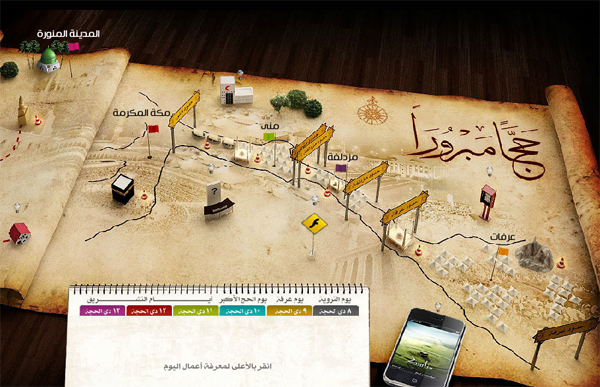
Pilgrims began the journey of faith on Wednesday, moving from Makkah to Mina, and on Thursday they moved to Mount Arafat for the Haj climax, before returning to Mina where three giant structures symbolizing “Satan” stand.
The faithful threw only seven small stones at the first pillar known as the “Big Satan” (Jamarat Al-Aqaba) on Friday.
“I am very proud that God has given me the opportunity to perform Haj,” said Ikramuddin Farooqui, from Allahabad, India. “May God accept our Haj.”
“I am so moved, I can't describe the happiness inside me,” a Syrian pilgrim said, tears streaming down his cheeks. “It is a dream come true.”
The Saudi leadership and its people came in for fulsome praise for the wonderful arrangements at the Jamarat complex.
"I was here some seven years ago and there were many deaths while performing this ritual," recalled Ibrahim Mohammad Kutty, an Indian pilgrim. "This place used to be like an ordinary pedestrian bridge and stampedes were a regular occurrence."
He prayed for the long life of Custodian of the Two Holy Mosques King Abdullah and other princes, governors and government officials for pouring billions of riyals into the Jamarat project and turning it into a massive multistory complex. "Stoning the devil has now become the easiest and most organized ritual ... God bless Saudi Arabia and its people," said an emotional Ibrahim Mohammad Kutty.
Pilgrims threw the small stones to cries of “Allahu Akbar,” or God is Greatest. According to tradition, the stoning ritual takes place at the site where Satan appeared to Prophet Abraham, to his son Prophet Ismael, and to Abraham's wife Hajera.
Prophet Abraham and his family each threw seven stones at Satan. The gesture has been perpetuated, and Muslims must perform it to complete the Haj.
Helicopters hovered constantly overhead to monitor the huge crowds with the help of thousands of high-tech cameras, all connected to a control room run by top security authorities.
After the stoning, pilgrims offered sacrificial meat, normally by slaughtering a sheep and even camels. Most of the sacrifices were slaughtered at a number of state-of-the-art abattoirs run by the Jeddah-based Islamic Development Bank (IDB). The meat is sent to poor countries.
Also on Friday, the pilgrims visited the Grand Mosque in Makkah to circumambulate the Holy Kaaba, the cube-shaped structure, seven times; it is called as Tawaf Al-Ifada. Some of the pilgrims also walked the 500 meters between Safa and Marwa seven times to commemorate Hajera’s run between the hillocks in search of water, before they take off ihram and don normal dress.
Delivering the Eid sermon in Makkah, Imam-e-Haram Sheikh Saleh Mohammed Al-Taleb called on Arabs and Muslims to take “practical and urgent” steps to stop bloodshed in Syria that has killed some 30,000 people, and urged world states to assume their moral responsibility towards the conflict.
“The world should bear responsibility for this prolonged and painful disaster (in Syria) and the responsibility is greater for the Arabs and Muslims who should call on each other to support the oppressed against the oppressor,” said Sheikh Al-Taleb.
"The solution should be practical and urgent because the oppressor becomes even more fierce as the days pass," he said.
“The world should take moral and legal responsibility against the massacres and the oppression that the Syrian people are subjected to as well as the continuing violations in Palestine,” Sheikh Al-Taleb, one of the most senior religious scholar in the Saudi Arabia, said.
“The war and destruction should be stopped and the higher interests should be ahead of personal interests in order to stop the spill of the Muslims' blood,” he added.
The stoning ritual continues over the next two days during which pilgrims will hurl seven stones every day at each of the three massive structures. They used to be mere pillars in the past.
http://www.arabnews.com/pilgrims-sto...-saudi-efforts
Rabu, 24 Oktober 2012
Millions of pilgrims head to Mina as hajj 2012 officially kicks off
Muslim pilgrims circle the Holy Kaaba and pray at the Grand mosque during the annual Hajj in the holy city of Mecca.
(Info-graphic design by Farwa Rizwan)
Wednesday, 24 October 2012
Millions of pilgrims arrived this week in Mecca for Islam’s annual Hajj (pilgrimage), which officially starts on Wednesday. Around four million pilgrims were heading to Mina, where they will spend their night before heading to the Mount of Arafat in the early hours of Thursday.
Many pilgrims began leaving for Mina on Tuesday night after circumambulating the Holy Kaaba, the first house of worship on Earth, built by Adam. Prophet Ibrahim and his son Ismail rebuilt it some 5,000 years ago. Most Hajj rituals are related to Prophet Ibrahim, his wife Hager and his son Prophet Ismail, and thus reflect the unity of humanity.
The Saudi government has given top priority to the security and safety of pilgrims and has deployed thousands of security forces in Mecca, Mina, Arafat and Muzdalifah, all cities within a radius of 10 kilometers, to ensure a safe and secure Hajj.
A statement by the Saudi Interior Ministry on Tuesday said that pilgrims were being transported to Mina smoothly without any obstacles, the official Saudi Press Agency reported.
The Grand Mosque, the focal point of the Islamic faith, was already teeming with joyful pilgrims at dawn on Monday, wearing the simple white folds of cloth prescribed for Hajj, many of them having slept on the white marble paving outside.
“I feel proud to be here because it’s a visual message that Muslims are united. People speaking in all kind of languages pray to the one God,” said Fahmi Mohammed al-Nemr, 52, from Egypt.
Hajj must be performed at least once in their lifetime by all Muslims capable of making the expensive, difficult journey, a duty that applies equally to Sunni and Shiite Muslims.
Saudi leaders have emphasized it is a strictly religious occasion and they are prepared to deal with any troublemaking.
Last year nearly 3 million pilgrims performed the Hajj, with roughly a third from inside the conservative kingdom. The Saudi authorities said there have so far been 1.7 million arrivals from abroad and about 200,000 from inside Saudi Arabia.
Mecca’s merchants, famed across the Arab world, are already doing a thriving trade as pilgrims stock up on souvenirs such as prayer beads and mats, Qurans, dates, gold and Zamzam water, pumped from a holy well.
“The first time I saw the Kaaba I cried with joy. I prayed for myself and all Muslims,” said Nafisa Rangrez, 36, from Gujarat in India, who had waited five years for a Hajj visa, according to Reuters.
All Muslims must face towards the Kaaba, the huge black cube at the center of the Grand Mosque, five times a day for prayer, making a visit to the sanctuary a powerful experience. Pilgrims must circle it seven times when they arrive in Mecca.
Wednesday is the first official day of the pilgrimage, with Muslims following a set form of rites laid out by the Prophet Mohammed and culminating on Friday with the Eid al-Adha (Feast of the Sacrifice), a holiday across the Islamic world.
“I would love to live here for the rest of my life. There’s no such place in the entire world. This is a blessed country,” said Ziad Adam, 23, a theology student from Kenya.
“It’s my first time in Mecca for pilgrimage. I can’t wait to pray in Arafat,” 32-year-old Koara Abdul Rahman, a businessman from Burkina Faso, told AFP.
“Right now, I’ve got all the good feelings you can think of,” said an Iranian pilgrim, her voice quivering and tears welling.
Saudi Arabia’s king is formally titled Custodian of the Two Holy Mosques and the ruling family has long reigned on its guardianship of Islam’s birthplace.
Over the past decade it has spent billions of dollars expanding the Grand Mosque and building new infrastructure to avert the stampedes and tent fires that marred past pilgrimages with hundreds of deaths.
In 2011, Saudi Arabia began the biggest expansion yet of the Grand Mosque, to increase its capacity to 2 million. A new railway will link the holy sites around Mecca.
This year alone, the kingdom spent more than 1.1 billion riyals ($293.3 million) on development projects in the holy sites of Mina, Arafat and Muzdalifah, all outside Mecca, according to AFP.
http://english.alarabiya.net/article...24/245606.html
Al Arabiya goes inside the basement of al-Jamarat Bridge
The basement houses automated collection and sorting machines
for the pebbles used in the stoning ritual

for the pebbles used in the stoning ritual
24 October 2012
The basement of al-Jamarat Bridge lies 15 meters underground, and Al Arabiya got the opportunity to see the automated method of gathering, storing and sorting the pebbles used by pilgrims in the stoning ritual that takes place above the three basins.
“This system works according to electric gates. It removes all the pebbles that have been gathered in al-Jamarat’s basin.”
Each of the basins of al-Jamarat has two machine systems that transfer the pebbles from the bottom of the bridge at different speeds. This system has gates that are electronically controlled to m`nage the pebbles course, quantity and destination. It also features sorting censors that filter and isolate everything that is thrown into the pit.
“The quantities of pebbles, when reached 1000 tons, are relocated after the Hajj period and after the pilgrims have departed from Mashaal. These quantities are sent to special locations.”
The remainders at al-Jamarat Bridge reach 300 tones according to official statistics that have been recorded from previous years’ experiences. The electronic system, which works through electronic gates located in each floor of al-Jamarat Bridge, simplified the process of redirecting the pebbles towards compressors at the bottom of the bridge.
Each corner of the facility shows the quick development that occurred from the top to the bottom of the bridge. The basement houses meticulous organization of surveillance cameras and general safety measures. The routes of the bridge’s vehicles also demonstrate the modernization of al-Jamarat Bridge.
video inside: http://english.alarabiya.net/article...24/245709.html
Selasa, 09 Oktober 2012
Langganan:
Postingan (Atom)